
The hybrid war against Ukraine, which has started during the Revolution of Dignity and still going, demands counteractions and introduction of a specific policy in response to challenges from the Government. However, defending national security it is important to take the international standards of human rights into consideration. During about four years, Ukrainian courts have handed out 118 courts decisions connected to violations on the Internet. Who was convicted? Were the crimes really dangerous for the country? How to counteract the war effectively establishing liability for dissemination of information online consistent with humanistic standards?
On April 18, nonprofit organization Human Rights Platform presented the results of analysis of court decisions handed down in 2014-2018 concerning online posts containing illegal information. The study included court decisions published in the Registry of Judgments.
Having no access to primary sources, the experts did not analyze the content of the posts.
The report is based on the presumption: if a court find a violation and its decision come into effect the content is illegal.
WHAT DID THE ANALYSIS SHOW?
The HRP found 118 court decisions in the Registry of Judgments, which were passed during four years under the articles:
Most court decisions were about statements connected to national security of Ukraine.
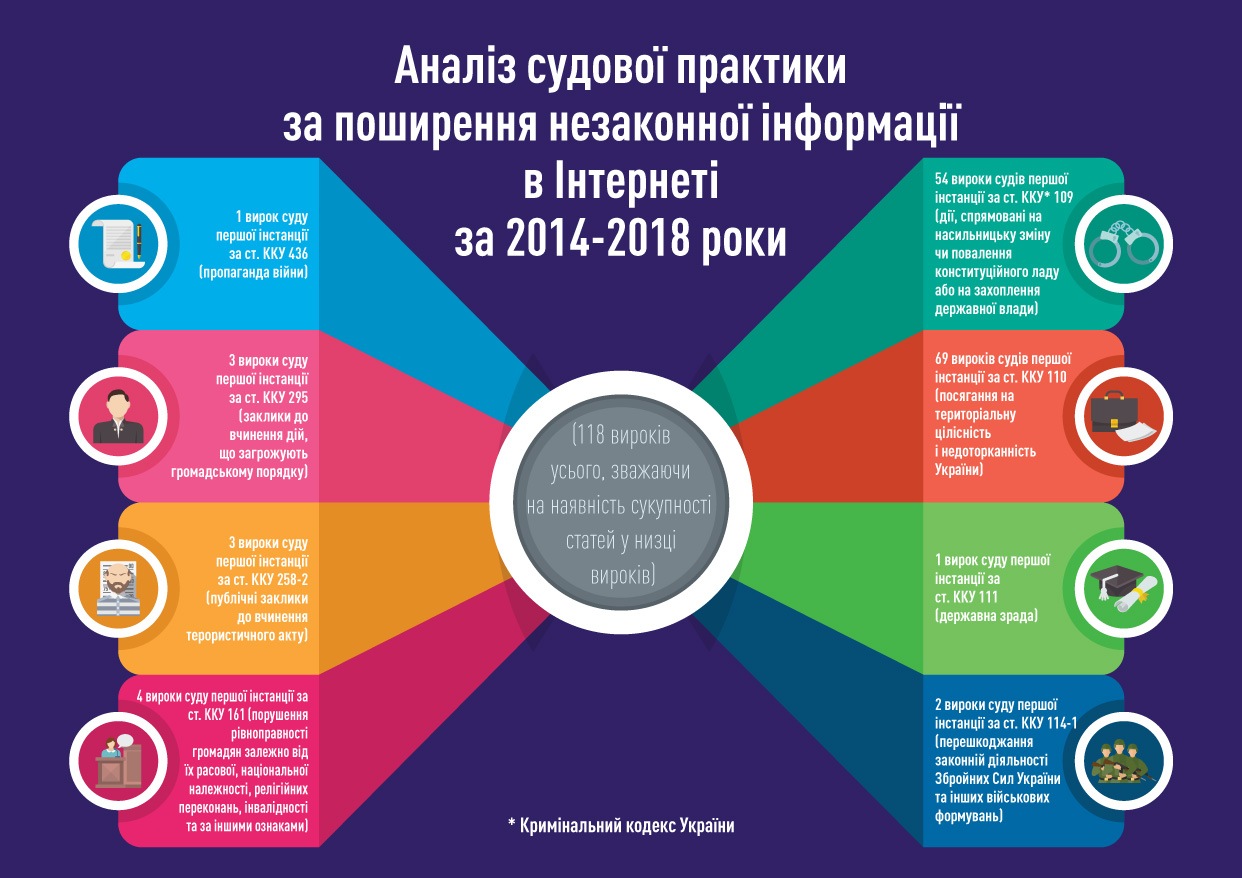
In particular, 69 decisions were about encroachment upon the territorial integrity and inviolability of Ukraine and 54 – actions aimed at violent change or overthrow of the constitutional order. About 1-4 court decisions were passed under other articles.
Most criminal cases were related to the posts in social networks VKontakte and Odnoklassniki (82%). The leader of crimes is VKontakte, where 37 of 54 crimes committed under Art.109 and 53 of 69 crimes – under Art.110 of the Criminal Code of Ukraine.
Ten of 54 crimes were recorded on Odnoklassniki. Those cases concerned with either violent change or overthrow of the constitutional order or the seizure of state power. Seven of 69 posts were related to encroachment upon the territorial integrity and inviolability of Ukraine.
Illegal content has been also distributed on Facebook: eight of 54 (15%) cases recorded. In those cases, the convicted people were charged with violations of the Article 109 of the Criminal Code of Ukraine. Three more cases were related to the Article 110.
The convicted people posted about 4% of illegal content on Youtube, while up to 4.3% of the messages were posted on all other web resources.
In most cases, the offenders acted independently. Courts identified prior conspiracy with a group of people in 6 cases (5%) only. Connection between convicts and the aggressor state was established in 8 crimes. It is about 7% of the total volume of court decisions analyzed.
WHAT SANCTIONS ARE IMPOSED?
In 74% of cases, the convicted concluded agreements with the Prosecutor, confessing their guilt. More than 80% of cases ended in releasing the convicted from serving sentences establishing probation period from one to three years.
“This suggests that the State does not see significant danger for the society in spreading such information as well as the danger these people might pose”, media lawyer of Human Rights Platform Lyudmila Opryshko commented.
Only 17 cases (14.5%) resulted in imposing imprisonment sentence. At the same time, 10 of them had a set of crimes, and in five cases the courts sentenced the offenders in absentia. Fines were imposed in three sentences handed down and correctional labour – in one.
THE QUALITY OF COURTS DECISIONS
Human rights defenders also emphasize improper motivation of court decisions. Judges do not analyze the text of messages leading to criminal cases. They entrust forensic experts to evaluate facts of crimes.
“Judges cite information that became a subject of a crime referring to the experts’ opinions and impose a punishment. Whereas the international standards say that if a court is authorized to restrict access to information then a judge is personally obliged to analyze both content and context to hand down a decision. However, courts do not do this “, Lyudmila Opryshko says.

Moreover, the forensics are conducted by institutions subordinated to executive authorities, so they cannot be considered independent. Human rights defenders stress that this undermines the right to an impartial and fair trial.
Experts are outraged by such a formal approach of judges to national security. Therefore, imposing sentences, courts ignore impact of illegal content on audience. They do not take into account a number of reached people at all – whether a message was distributed among 30 people or 27 thousand users. Judges still impose the same punishment.
“During the hybrid war, when we are trying to protect interests of Ukraine, the factor of influence should be decisive. In judgement delivered in the case of “Savva Terentyev v. Russia” the European Court of Human Rights noticed that the courts had not investigated the impact of post about burning “infidel cops”, like at Auschwitz” on an audience”, Lyudmila Opryshko says.
At the same time, authors of the report believe that there is no need to “create a bicycle” expanding the definition “information terrorism”, as deputies proposed in the bill No.6688. The Criminal Code contains the articles that allow punishing information support of terrorism. The experts have provided examples of cases when courts had identified information support of terrorism as part of “other support of terrorism.” In addition, experts have not noticed any court decision ordering what to do with unlawful information.
“It’s not clear if that content was deleted – before the sentence was imposed or after. Looks like that is not important for judges. Although, to my mind, this is precisely the protection of interests of the state. If criminal content can be distributed, it should be removed”, Lyudmila Opryshko says. She notes that 80% of cases resulted in suspended sentences. An offender on probation is ordered to fulfil a number of obligations. So courts can oblige the convicted to remove unlawful information otherwise courts can replace suspended sentence with jail sentence.
Moreover, experts are astounded to learn that courts use information from the portal “Myrotvorets” as the only source of evidence. It means, courts do not verify such evidences for reliability and validity.
SOCIAL NETWORKS AS MEDIA
Experts found that courts had considered social networks VKontakte and Odnoklassniki to be media. At the same time, the article 109 (actions aimed at either violent change or overthrow of the constitutional order, or at seizure of state power) provides a harsher sentence if media is involved in a crime committed.
“VKontakte has a lot of users, and information published in it is open for all without any restrictions. In its turn, the internet including VKontakte are intended for public distribution and mass reception of audio-visual information as an electric signals over electronic devices “, – authors are citing one of court decisions.
But experts point that this interpretation is contradicted other legal practice in Ukraine: law enforcement agencies do not admit the Internet media as subject of media legislation while investigating crimes against journalists.

“When the updated Law On Information was adopted (2011) I told about importance of protection of journalists working for online media, because they are also media and should be protected by the Art. 171 and Art. 345 of the Criminal Code of Ukraine. But it has turned out that it does not work when journalists working for online media are beaten, however it works when there is need to increase criminal liability for distribution of content”, Olexander Burmahin wonders. Human rights defender remind that lack of proper quality legislation is a breach of state obligations according to recommendations of the Council of Europe.
“The absence of these mechanisms results in manipulation, abuse and violations of human rights. The fact we do not have efficient and civilized mechanisms is a big question to the state”, he adds.
WHAT TO DO?
Human rights defenders are convinced that to improve the situation with proper prosecution for illegal information there is need in trainings, in particular for judges.
“Recently, acting as a lawyer in a defamation case, I even thought to bring a flipchart to the court to explain the judge how Internet technology works through the pictures because the judge is just incompetent in this area. It is not because she is not professional. The technology and legislation are so quick today that judges do not have time to monitor the changes. Therefore, they need to update their skills. Number of such cases will increase due to quick technology development”, Olexandr Burmahin says.
At the same time, the FreeNet Сoalition’s experts insist on the importance of finalizing the Internet legislation. Having the war with Russia for five years the government has not introduced the law containing “rules of the game” which would take the international human rights standards in to account. They note that the military aggression of Russia against Ukraine, including in cyberspace has highlighted the importance of separate legal regulation.
In turn, the Deputy, Olga Chervakova agrees that the public sector and experts from the relevant industry should participate in developing of new Internet policy. Indeed, parliamentarians are often inexperienced in technology and human rights area.
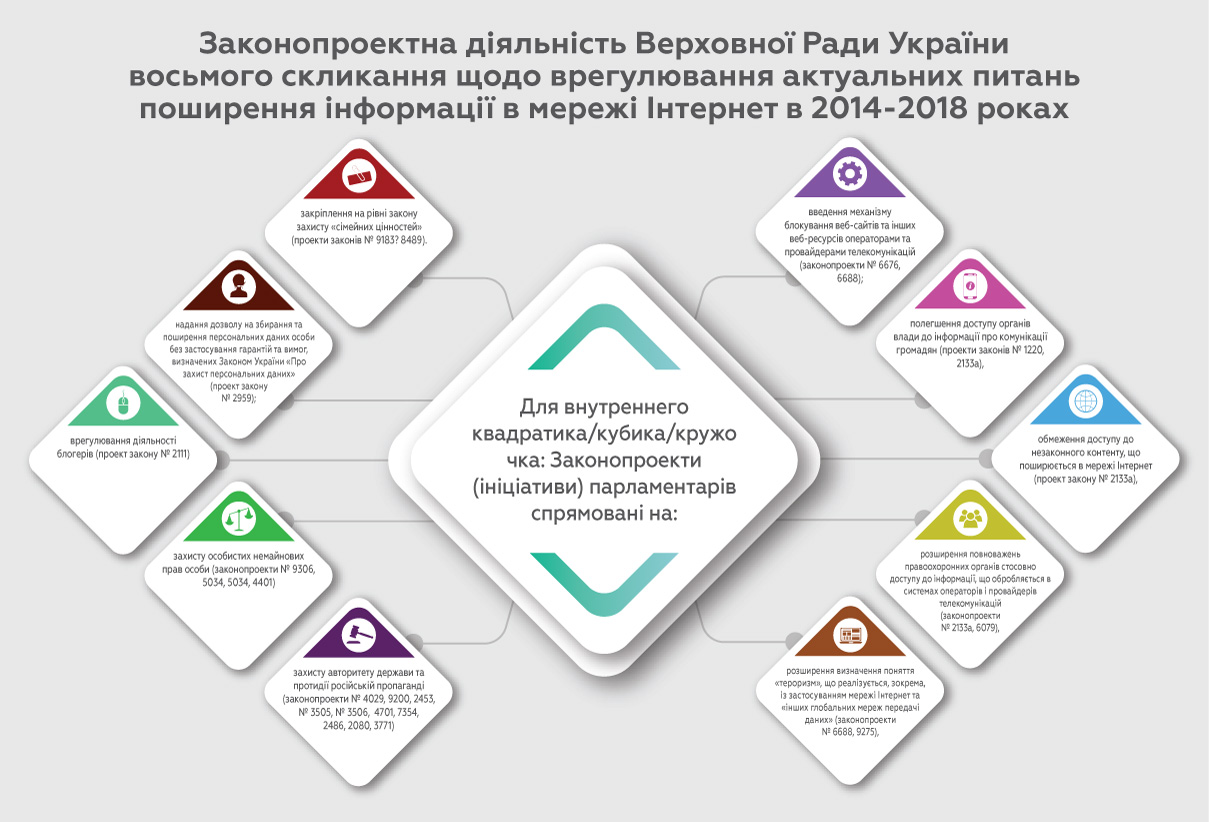
“The Security Service of Ukraine proposed the draft law No. 6680 not out of spite. They tried to do their best. We need to bring flipchart not only to courts, but also to the Prosecutor General’s Office, and the Ministry of Internal Affairs. Two flipcharts must be brought into the parliamentary committee, because it takes a long while to clarify the “Maslow Pyramid” with the basic values and international obligations of Ukraine. Deputies always ponder, what more important – whether it is freedom of speech or interests of national security and made choices are often in favour of the latter. However, all the discussions are crashed against the question of what the Maidan was standing for, “- explains Olga Chervakova.
Mykola Mirnyi, journalist of the Human Rights Center ZMINA
According to the results of the study the “FreeNet” Coalition issued a resolution outlining the important issues that should be given special attention in developing legislation on the Internet.
